Our Journey
Experience the ancient pilgrimage route along the stunning Finisterre coastline. A transformative journey designed for leaders seeking authentic connection and personal growth.
Coastal Route
Walk along the beautiful Finisterre coastline.
Unique Stays
Carefully selected accommodations along the way.
Guided Experience
Expert guides to enhance your journey.
Finisterre History and Settting
Click on Finisterre tab above.
Step away from the noise. Walk back to what matters.

Arrival in A Coruña
Every journey begins with a moment of transition. Participants arrive on the Atlantic edge of Europe, in A Coruña, where land, ocean, and history have met for centuries. It is the first pause before the road begins — a moment to step out of airports, agendas, and constant movement.
First taste of Galicia
The city offers a first taste of Galicia: the open Atlantic, long seafront promenades, stone squares full of life, and the quiet presence of the ancient Tower of Hercules, still watching over the coast as it has for nearly two thousand years.
A moment to arrive
There is no rush. The purpose of the day is simple: to arrive. A short walk through the city allows the group to begin adjusting their rhythm. Conversations start naturally, curiosity replaces routine, and the distance from everyday life begins to grow.
Welcome dinner by the sea
Later, by the sea, the group gathers for the first dinner. Local flavours, the sound of the Atlantic, and the calm of the coastline create the setting for the beginning of the experience. The road has not started yet. But something already has.

Beginning in Lires
The Camino begins on the Atlantic coast, in the quiet village of Lires, a small rural enclave overlooking the Ría de Corcubión where the landscape of the Costa da Morte sets the tone for the journey ahead.
Walking toward Fisterra
From here, the group takes its first steps toward Fisterra. The road moves through coastal paths and open Atlantic views, allowing the rhythm of walking to replace the rhythm of everyday life. Conversations begin to flow, silence becomes comfortable, and the journey starts to take shape.
Cape Finisterre Lighthouse
The day ends at the iconic Cape Finisterre Lighthouse, standing above the ocean at what the Romans once called Finis Terrae — the end of the known world. Here, where the land meets the Atlantic horizon, the first day of the Camino closes with one of its most symbolic moments: watching the sun slowly disappear into the ocean.
A symbolic ending, a deeper beginning
A powerful sunset that, for centuries, has marked the place where the world seemed to end. Yet, it is also the beginning of something deeper.

Leaving Fisterra behind
The day begins in Fisterra, where the Atlantic still marks the horizon and the rhythm of the Camino has already begun to settle in.
Following the coastline
Leaving the lighthouse behind, the path continues along the coastline, gradually moving between open ocean views and quiet rural stretches. Walking becomes more natural now. Conversations appear and fade, sometimes replaced by long moments of silence shaped by the sound of the sea and the steady rhythm of footsteps.
Arrival in Cee
The road slowly leads toward Cee, a traditional coastal town that has lived for centuries from the Atlantic — fishing boats, small harbours and the everyday life of Galicia’s maritime communities.
A different kind of distance
By the time the group arrives, the journey already feels different. The distance walked is not only measured in kilometres, but in the calm clarity that begins to emerge when the noise of everyday life fades away.

Leaving the Atlantic behind
The journey continues from Cee, gradually leaving the Atlantic behind and moving inland through the quiet rural landscapes of Galicia.
The rhythm deepens
Forest paths, open countryside and small villages shape the route toward Olveiroa, a place where the simplicity of rural life reflects the spirit of the road itself.
Space for reflection
By this stage of the journey, walking has become something more than movement. It creates space — for reflection, for conversation, and for the kind of clarity that rarely appears in the pace of everyday professional life.
Arrival in Olveiroa
Olveiroa welcomes the group with calm and silence. A small traditional Galician stone village, it feels far removed from the noise of modern life, offering the perfect setting to pause and reconnect with the quiet essence of the Camino.

The living coast
Somewhere along the coast, the Camino slows for a different kind of experience — a moment to connect with one of Galicia’s oldest traditions: the relationship between the sea and the communities that have lived from it for generations.
Fishing village traditions
In a small fishing village, the group steps into the daily rhythm of the Atlantic, visiting the local fish market where boats bring in the day’s catch — fresh fish and shellfish that have sustained these coastal communities for centuries. Here the Camino reveals another side of Galicia: the people who shape its identity.
Redeiras and palilleiras
Among them are the redeiras, the women who repair and weave the fishing nets used by the fleets, preserving a craft essential to life along the Galician coast. Alongside them, the palilleiras continue the delicate tradition of handmade lace, transforming thread into intricate patterns through knowledge passed down across generations.
Shared table by the Atlantic
The day closes around a shared table, celebrating the flavours of Galicia — seafood, local wines and conversation — in a place where tradition, community and the Atlantic remain deeply connected.

Starting from Santa Mariña das Maroñas
The journey continues from Santa Mariña das Maroñas, a small rural hamlet surrounded by soft hills and the quiet landscapes of inland Galicia.
Walking through stillness
By now, the rhythm of the Camino feels natural. The path moves through forests, farmland and small village roads where time seems to pass more slowly. Walking becomes almost meditative — a space where thoughts settle and conversations unfold without effort.
Toward Negreira
The route gradually leads toward Negreira, a historic town shaped by centuries of pilgrims crossing the region on their way to the coast.
Pause and gather
Set along the Tambre river, Negreira offers a peaceful setting to pause, reflect and gather again after another day on the road — a reminder that the Camino is as much about the moments between destinations as it is about the places themselves.
The final stage
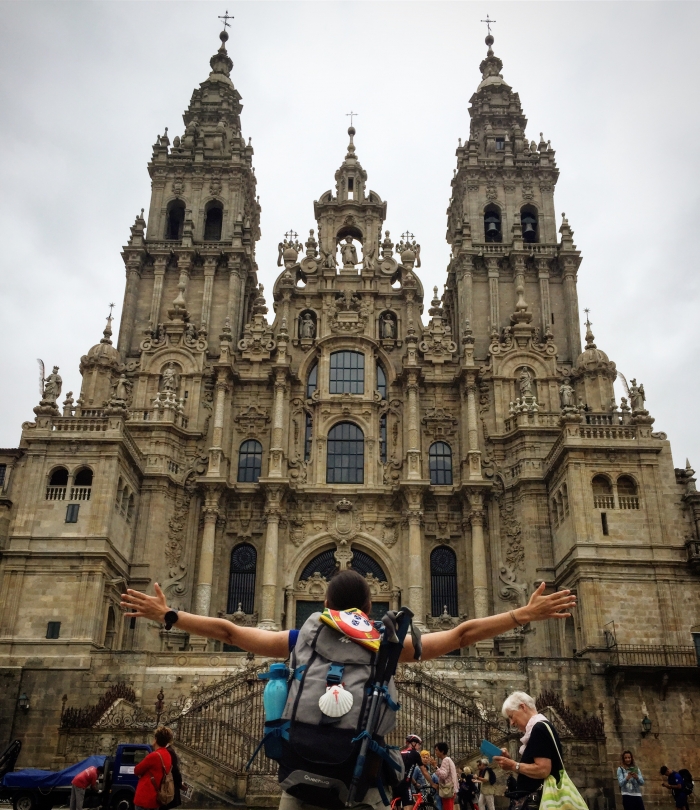
The final stage begins in Negreira, where the Camino gently leads the group through forests and rolling Galician countryside on the way to one of the most symbolic destinations in Europe.
Walking as a shared language
By now, the rhythm of the road is fully present. Walking has become a shared language — a space for reflection, quiet conversation and the sense that something meaningful has unfolded along the way.
Arrival in Santiago de Compostela
Gradually, the landscape begins to change. Paths give way to the outskirts of the city until the group finally enters Santiago de Compostela, where pilgrims have been arriving for more than a thousand years. The journey culminates in the historic heart of the city, beside the Cathedral of Santiago de Compostela — a place that has marked the end of the Camino for generations.
Celebration and closure
After days of walking, the arrival is less about reaching a destination and more about recognising the journey itself. A moment to pause, celebrate and share the experience before the road finally comes to rest.

Final morning in Santiago
The journey ends where many paths have ended for centuries: Santiago de Compostela. The final morning begins slowly. After days of walking, conversation and shared experiences, breakfast becomes a moment to look back at the road travelled together — the landscapes, the silence, the ideas, and the connections formed along the way.
A quiet ending
There is no ceremony required. The Camino rarely ends with a grand moment. Instead, participants leave with something quieter but more lasting: perspective, renewed energy, and the feeling of having paused long enough to see their path with greater clarity. From here, everyone returns to their own journey.
Camino Finisterre
Follow our 100km route through the most beautiful landscapes of Galicia